


High-Amplitude Vibration Isolation for Military and Avionics Systems
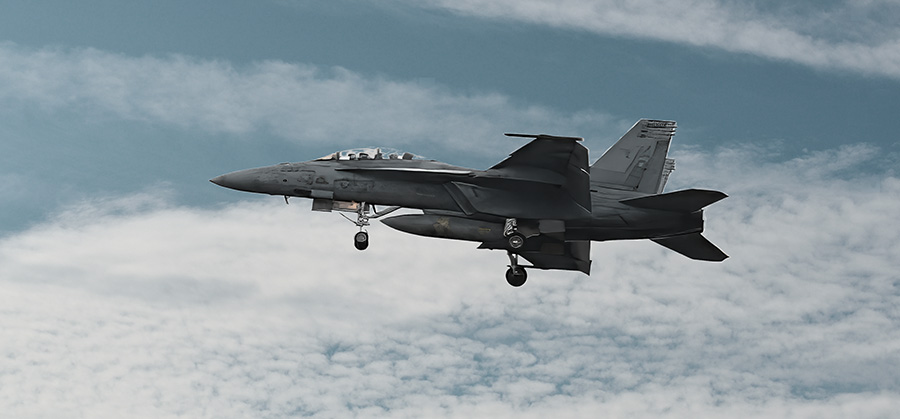
Military vibration isolation and avionics vibration isolation present unique engineering challenges. Ground vehicles traverse rugged terrain under heavy loads, while shipboard electronics endure wave impacts, explosive shock and engine vibration. Avionics equipment faces turbulence, rotor effects and high-amplitude shock events during takeoff and landing.
High-amplitude vibration subjects components to large displacement, high acceleration and broad-frequency inputs that amplify through resonance and create multi-axis excitation. The consequences are severe — premature or even immediate component failure, misalignment and calibration drift, connector fatigue and electrical faults that compromise mission-critical systems.
But isolation design is often treated as an afterthought. Engineers focus on load capacity and physical fit, selecting mounts based on static requirements rather than dynamic behavior. This approach fails in high-amplitude environments where damping, transmissibility and displacement are critical performance factors.
High-amplitude vibration demands a design approach that prioritizes dynamic performance and matches isolation strategy to the specific shock and vibration profile of the application. This guide provides the framework you need to select, specify and deploy isolation systems for extreme defense and avionics environments.
Engineer Quick Reference: High-Amplitude Isolation Strategies
When designing for high-amplitude vibration in military and defense applications or the aerospace industry, start with this selection framework:
| Isolation Type | Best For | Key Advantage | Limitation | |
|---|---|---|---|---|
| Liquid Damped Mounts | Severe, high-amplitude environments | Maximum damping, low transmissibility | Weight capacity | |
| Elastomeric Cup Mounts | Space-constrained systems in multiple environments | Compact, durable, balanced damping, fail safe | Lower peak damping | |
| SP Series |
| Compact, lightweight, vibration isolation | Low frequency isolation |
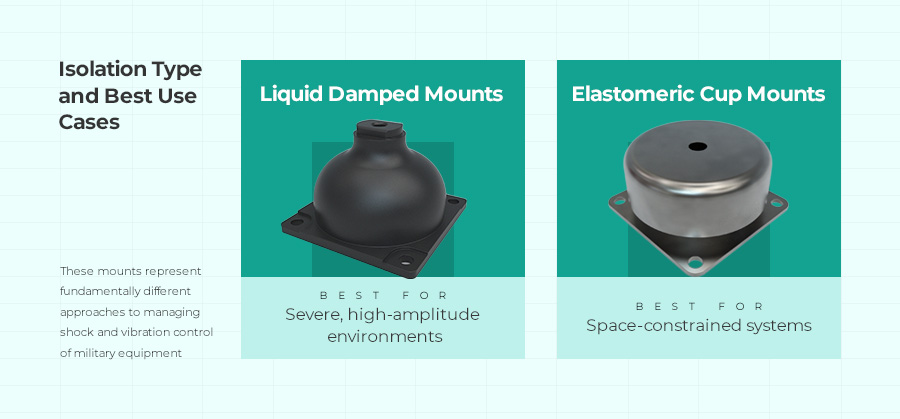
These vibration-damping mounts represent fundamentally different approaches to managing shock and vibration control of military equipment. Liquid-damped mounts excel in extreme environments where maximum energy dissipation is required. Elastomeric mounts deliver functionality in challenging environments, and the SP Series offers balanced performance where installation space and weight are constrained.
Understanding High-Amplitude Vibration and Shock
High-amplitude vibration differs from standard vibration in three critical ways:
Large displacement: Measured in inches rather than thousandths.
High acceleration: Often reaching double-digit G levels or higher in military and avionics applications.
Broad-frequency input: Spanning multiple octaves simultaneously.
Common sources include engine harmonics in ground vehicles driving across rough terrain, wave impact and propeller-induced forces in shipboard systems, and turbulence combined with rotor effects in avionics installations. Real-world systems experience multi-axis excitation where vertical shock couples with lateral vibration, creating complex loading that simple mounts can’t manage.
When excitation frequency approaches the natural frequency of a mounted component, transmissibility increases significantly — input forces can be amplified many times over at the component level. In vibration analysis, engineers rely on Power Spectral Density (PSD) plots to visualize how vibration energy is distributed across frequencies, making it easier to identify frequencies where resonance and high transmissibility could occur.
Military and avionics systems experience mixed-mode environments where shock transients overlap with continuous random vibration. Designing for one without the other creates blind spots that lead to field failures.
Why Isolation Systems Fail in Military Applications
Most isolation failures stem from four common engineering errors, each rooted in treating vibration isolation as a parts selection problem rather than a dynamic performance challenge.
The stiffness of the isolation system primarily determines natural frequency. Engineers often select mounts that are too soft in an attempt to lower the natural frequency, but this can cause the system to couple with low-frequency environmental vibration. The result is instability and poor fatigue life due to excessive deflections and increased stress cycling. It’s crucial to select a natural frequency that avoids dominant excitation frequencies while ensuring structural integrity.
Damping determines how vibrations are absorbed or transmitted near resonance and during shock events. Low damping can result in high amplification at resonance and large deflections in response to shocks, leading to potential component failures. However, excessive damping can undermine isolation effectiveness at higher frequencies, transmitting unwanted vibration directly to the protected component. Aircraft systems, in particular, have experienced flutter and vibration-related failures that often trace back to inadequate or poorly chosen damping.
Ignoring transmissibility curves compounds the problem. Load capacity and deflection data tell you what the mount can support, not how it will perform dynamically. Mounts may exhibit unacceptable transmissibility at resonance, significantly amplifying input forces.
Designing for static load instead of dynamic input is the third failure. UAV vibration environments demonstrate why this fails — rotor-induced harmonics create cyclic loading that fatigues connections and accelerates wear even when peak loads stay within rated capacity.
Environmental conditions finish what poor design starts. Temperature extremes degrade elastomers, salt spray corrodes metal components and vibration-induced fatigue cracks emerge after thousands of cycles. When the F-35 program experienced component failures under operational stress, inadequate isolation design contributed to maintenance costs and mission risk.
Core Design Principles for High-Amplitude Isolation
Effective shock and vibration control of military equipment requires balancing five interdependent parameters — damping, stiffness, transmissibility, displacement and environmental constraints.
Damping Requirements
Damping is an intervention for certain types of vibration on a given system, while stiffness determines natural frequency and displacement. For high-amplitude applications, moderate damping ratios are recommended — sufficient to suppress resonance without sacrificing high-frequency isolation. Insufficient damping risks amplification, while excessive damping increases transmissibility above resonance.
Softer mounts provide better isolation but require more displacement to absorb energy, while stiffer mounts reduce motion but increase force transmission. Reducing stiffness increases displacement proportionally for the same load, which is why space-constrained installations often compromise isolation effectiveness.
Transmissibility Control

Below the natural frequency, all mounts transmit nearly 100% of the input. At resonance, all systems amplify input vibration, but the degree of amplification is much higher in systems with low damping. Above resonance (typically 1.4× natural frequency and higher), properly designed systems attenuate.
Environmental Constraints
MIL-STD-810H defines shock profiles for ground systems. MIL-STD-167-1A establishes requirements for shipboard installations. Both demand isolation systems with sufficient displacement capacity to absorb high-energy transients without bottoming out.
Multi-axis requirements reflect reality. Ground vehicles experience vertical shock from terrain combined with lateral acceleration during maneuvers. Aircraft encounter turbulence in all three axes simultaneously.
LD Series Liquid Damped Mounts
The LD Series liquid-damped mount provides maximum shock and vibration attenuation for severe military and avionics environments through construction that combines elastomeric support with fluid-damping technology.
At the core is a silicone gel that converts kinetic energy into heat. This silicone gel vibration isolator achieves high damping ratios through viscous energy dissipation, unlike conventional elastomeric mounts that rely solely on material hysteresis. This approach reduces transmissibility at resonance while maintaining effective isolation above natural frequency.
Silicone gel formulations exhibit high loss tangent across broad temperature ranges, dissipating energy efficiently whether installed in desert heat or arctic cold. LD Series mounts maintain stable performance from -40°F to 195°F across operating environments.
Construction combines stainless steel housings with elastomeric elements to create a sealed assembly resistant to environmental degradation. The all-metal exterior protects against corrosion in shipboard installations where salt spray accelerates material breakdown.
These mounts excel where maximum vibration reduction is required. Shipboard control systems benefit from superior shock resistance, ground vehicle electronics racks gain protection from high-amplitude terrain inputs, and avionics equipment in helicopters and transport aircraft sees reduced fatigue from rotor-induced harmonics.
Elastomeric Cup Mounts
Elastomeric cup mounts deliver balanced vibration isolation in a compact package designed for space-constrained military and avionics installations where maximum damping isn’t required, but reliable performance is essential.
These mounts achieve moderate damping through careful material selection and geometry optimization. The elastomeric compound provides both the spring element and the damping mechanism in a single component. Fundamental properties of elastomeric materials make them ideal for applications requiring moderate isolation with minimal installation volume.
The cup geometry creates a progressive spring rate that stiffens under high loads, providing overload protection without mechanical stops. This is particularly valuable in aircraft applications where hard landings subject avionics to spike loads beyond normal operating conditions.
Temperature stability across a range of extreme operating conditions covers Arctic operations through desert deployments. Elastomeric materials maintain consistent isolation performance across military specification temperature ranges. Chemical resistance to fuels, hydraulic fluids and cleaning solvents prevents degradation in maintenance environments.
Electronics enclosures in ground vehicles, rack-mounted avionics in aircraft and portable military equipment all benefit from the small footprint.
When to Use Liquid Damped vs. Elastomeric Mounts
Choosing between liquid-damped and elastomeric isolation requires evaluating application requirements against performance characteristics.
Damping Performance
Liquid-damped mounts deliver superior energy dissipation with higher damping ratios, making them the clear choice for severe shock environments like shipboard weapons systems or ground vehicles operating in extreme terrain. Elastomeric mounts provide moderate damping, sufficient for most avionics installations.
Space Constraints
Elastomeric cup mounts occupy minimal volume, fitting into tight electronics enclosures and rack-mounted configurations where every cubic inch matters. Liquid-damped systems require additional clearance for the fluid chamber and housing.
Environmental Exposure
Environmental exposure affects long-term reliability. Fluid damping technology maintains consistent performance across temperature extremes and resists degradation from repeated shock loading. Elastomer dynamics show greater temperature sensitivity, though modern materials minimize this effect within military specification ranges.
Weight and Load Requirements
Weight considerations matter in aircraft applications where every pound affects payload capacity and fuel efficiency. Elastomeric mounts deliver acceptable performance with minimal weight penalty. Liquid-damped systems add weight but provide superior protection for sensitive avionics.
Cost vs. Performance Trade-Off
When mission-critical equipment requires maximum vibration reduction, liquid-damped mounts justify a higher initial cost through reduced maintenance and improved reliability.
Designing for Real-World Military and Avionics Environments
Theory meets reality when shock isolation systems’ military applications must fit within existing platforms while meeting stringent specifications.
Ground Vehicle Electronics Racks
Ground vehicle electronics racks present the classic constraint problem. Isolation systems must absorb high-amplitude terrain inputs while fitting between the equipment frame and vehicle structure. Multi-axis shock from mine blasts creates loading conditions that far exceed commercial specifications.
Shipboard Control Systems
Shipboard control systems face different challenges. Wave impact generates low-frequency, high-amplitude motion requiring significant displacement capacity. Navy specifications like MIL-DTL-901E mandate shock qualification testing that simulates underwater explosions.
Avionics Equipment Mounting
Avionics equipment mounting in aircraft demands solutions that balance vibration isolation with weight constraints and installation space limitations. Commercial aircraft prioritize weight reduction to maximize fuel efficiency. Military aircraft add complexity with external stores, weapons systems and high-G maneuvers.
Long life cycle requirements mean isolation systems must maintain performance through thousands of flight hours or years of field deployment.
Common Mistakes in High-Amplitude Vibration Isolation
Four engineering errors account for most isolation system failures in military and avionics applications:
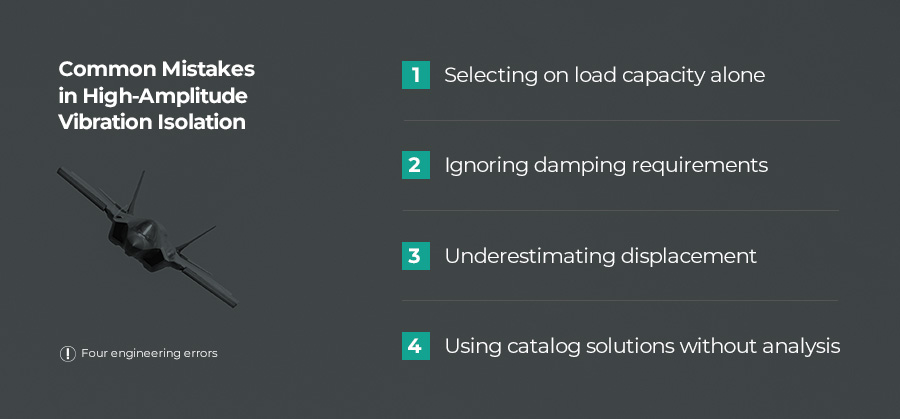
Selecting on load capacity alone: This ignores the dynamic behavior that determines actual performance. Mounts may exhibit unacceptable transmissibility at the frequencies where your system operates.
Choosing the wrong natural frequency: Selecting a mount whose natural frequency overlaps with environmental vibration causes severe amplification and can destroy sensitive components.
Underestimating displacement: Underestimated displacement requirements cause hard stops to occur where mounts bottom out during shock events, transmitting full impact force directly to protected equipment.
Using catalog solutions without analysis: Environmental degradation shortens service life. Elastomers that perform well at room temperature may change stiffness characteristics at temperature extremes. Understanding what vibration isolation is in the context of your application prevents these costly errors.
Working With IDC: Engineering Support for Vibration Isolation
Effective vibration isolation for defense systems demands application-specific design that accounts for dynamic loading, space constraints, environmental conditions and military specifications.
IDC provides technical consultation that starts with understanding your requirements. What shock and vibration profiles does your system face? What space is available for isolation? What military specifications must you meet? These questions define the design space before component selection begins.
Custom vibration solutions can integrate isolation with mounting hardware, adapt standard designs to fit within tight clearances or modify damping characteristics to match your specific frequency profile. Our engineering team will discuss your unique application and provide the expertise required for mission-critical isolation design.
Engineering for Reliability in Extreme Environments
High-amplitude vibration isolation in military and avionics systems demands engineered isolation solutions that prioritize dynamic performance. Load capacity confirms structural adequacy, but damping and transmissibility determine whether components survive or fail.
Match isolation technology to application requirements. Use liquid-damped mounts when maximum energy dissipation is required and space permits. Choose elastomeric solutions when compact dimensions and balanced performance meet your needs.
Successful isolation design requires understanding the physics of vibration control, applying appropriate military specifications and working with technical partners who provide comprehensive support.
FAQs About High-Amplitude Vibration Isolation
Engineers frequently ask how to select the right isolation solution for demanding military and avionics applications. Below are answers to the most common questions about high-amplitude vibration control.
What is high-amplitude vibration?
High-amplitude vibration involves large displacement (measured in inches), high acceleration (often reaching double-digit G levels or higher) and broad-frequency inputs that create complex multi-axis loading. It differs from standard vibration in severity and the dynamic response it demands.
How do liquid-damped mounts work?
Liquid-damped mounts use viscous silicone gel to convert kinetic energy into heat, achieving high damping ratios. The gel provides consistent energy dissipation across broad temperature ranges while maintaining isolation effectiveness above natural frequency.
When should I use elastomeric mounts?
Use elastomeric mounts when installation space is limited, weight constraints are critical and moderate damping provides acceptable vibration reduction. They excel in compact avionics installations where extreme shock levels aren’t encountered.
What is transmissibility?
Transmissibility quantifies force transmission as a function of frequency. Below the natural frequency, transmissibility approaches 1:1. At resonance, poorly damped systems amplify. Above resonance, properly designed systems attenuate.
How do I choose the right isolator?
Match isolation technology to your shock and vibration environment, space constraints and military specifications. Evaluate damping requirements, displacement capacity, environmental conditions and long-term reliability needs. Learn more about how to choose the right isolator for your application.
Why Trust IDC?
At IDC, we’ve spent decades engineering vibration isolation solutions for the defense and aerospace sectors, working directly with military system integrators, naval contractors and avionics OEMs who face the most demanding shock and vibration environments. Our team understands MIL-DTL-901E qualification testing because we’ve designed mounts that pass it. We know MIL-STD-810H and MIL-STD-167-1A requirements because we engineer to them daily.
Every recommendation we make is informed by real-world application experience — ground vehicle electronics that survived IED blasts, shipboard control systems that endured underwater explosion testing, and avionics installations that maintained calibration through thousands of flight hours. We don’t just sell vibration mounts. We solve engineering problems that directly impact mission success and equipment reliability in extreme operating conditions.
Work With IDC for Custom Vibration Isolation Solutions
High-amplitude vibration isolation is a technical challenge that requires specialized expertise, application-specific analysis and rapid response when you’re under deadline pressure.
IDC specializes in solving these challenges. Our team works with defense contractors, aerospace OEMs and military system integrators to design isolation solutions that meet stringent shock and vibration specifications, including MIL-DTL-901E, MIL-STD-167 and MIL-STD-810. We provide the stiffness data, load-deflection curves and step files you need to complete your analysis. We respond quickly when time is critical.
Whether you need liquid-damped mounts for severe shipboard shock environments, compact elastomeric isolators for space-constrained avionics installations, or custom assemblies engineered to your exact specifications, we offer the technical depth and manufacturing capability to deliver mission-ready solutions.
Contact our team to discuss your application. We’ll help you define your inputs, select the right isolation approach and provide detailed support throughout your design process. When shock and vibration performance is mission-critical, you need a partner who understands the engineering, not just a supplier shipping parts.
Request engineering consultation or download product datasheets to review technical specifications and performance data.
Speak with a Sales Representative
Our representatives have a wealth of knowledge on all our products – let them steer you in the right direction.
Learn More
